
one6G WG4 releases a technical report on ISAC-enabled detection of antenna tilt failures
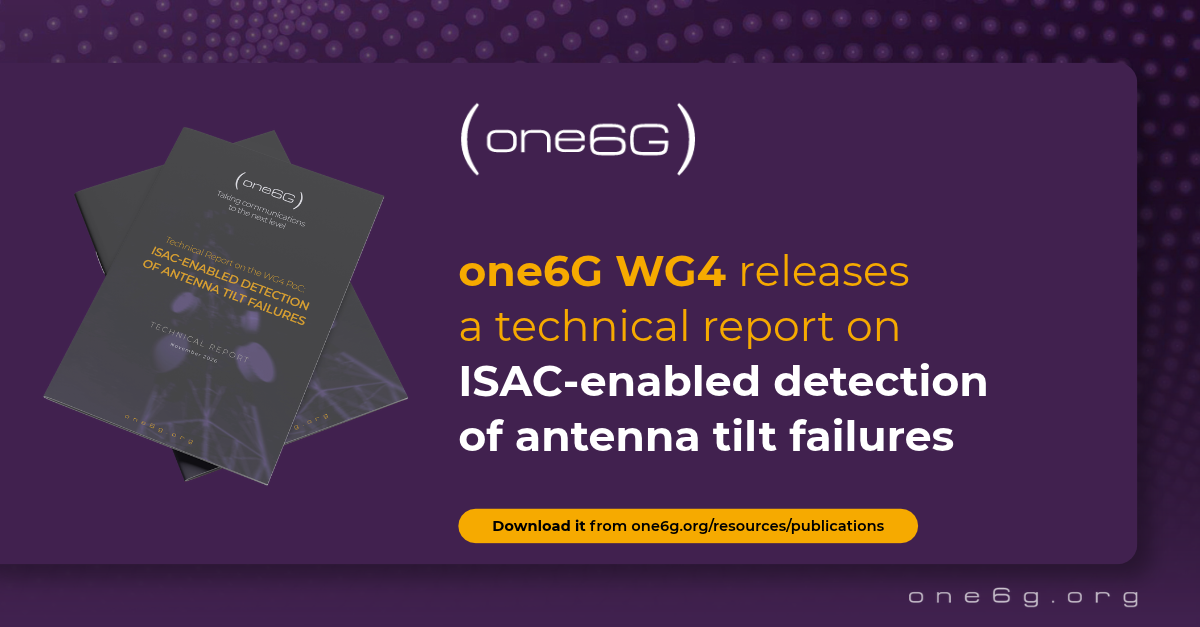
Most Integrated Sensing and Communication (ISAC) applications look outward, for example, mapping the environment or tracking targets. This work takes a different approach. It turns ISAC inward and uses it as a sensor-free diagnostic tool for the network’s own infrastructure. The aim is to detect and estimate physical antenna tilt failures caused by mechanical stress, windstorms, or long-term structural aging, as a step toward self-healing Radio Access Networks (RAN).
Why it matters
Antenna misalignment is a persistent operational challenge for mobile operators, leading to coverage holes, throughput degradation, and inter-cell interference. Today, tilt failures are typically found through manual site visits, drive tests, or dedicated hardware sensors. These approaches are costly and slow to react, and fitting a sensor to every antenna does not scale to ultra-dense 6G deployments. The report shows how base stations with ISAC capabilities could monitor their own physical alignment, without any additional hardware.
How the PoC was conducted
The PoC used Huawei MRC’s monostatic cmWave ISAC testbed, operating with a virtual MIMO architecture and a 400 MHz OFDM waveform. The same platform was previously used at the one6G Summit 2025 to sense the inclination of the Two Towers in Bologna. Measurements were carried out in two phases:
- Indoor validation campaign: Controlled tests with a TV screen and a desk table at a range of 3 meters. These confirmed that shifts in the sensed point cloud map reliably to physical tilt changes.
- Outdoor performance campaign: Tests with the antenna mounted at 15 meters on the Huawei MRC campus. The scenes covered a near-field building facade at 19 meters and an extended, cluttered scene between 30 and 146 meters.
Key results
Three algorithms working on 3D point clouds were benchmarked in the outdoor campaign. The best performer was a 3D Correlation Search with sub-grid parabolic refinement. It achieved a root mean square error (RMSE) of 0.358° in the near-field scene and 0.456° in the long-range, cluttered scene. Operators typically flag tilt faults at 1.0° to 1.5°, so this level of precision leaves a comfortable margin for reliable fault detection.
From detection to closed-loop automation
The report also outlines a provisional closed-loop roadmap in four steps:
- The base station senses its own coverage sector.
- Edge computing converts the sensing data into a 3D point cloud and estimates any tilt deviation in real time.
- The deviation is reported to the network management layer as telemetry.
- The system corrects small deviations automatically, through Remote Electrical Tilt (RET) for passive antennas or through beamforming weights for active antennas.
This approach avoids the capital cost of external IoT or gyroscope hardware and reduces the operational cost of manual audits and tower climbs.
The authors also set out the challenges that remain before commercial deployment:
- keeping the fault-free reference baseline up to date as the environment changes,
- running sensing on commercial TDD antenna units without reducing user throughput,
- managing the computing load at the edge,
- extending detection to azimuth and roll misalignment,
- standardizing the telemetry and control interfaces, for example through O-RAN E2 and O1.
With this report, one6G WG4 shows that ISAC can serve the network itself as well as the world around it, turning every base station into a tool for monitoring its own health. The results lay the groundwork for zero-touch, self-healing RAN in future 6G deployments. As next steps, the contributors plan to develop AI/ML-based estimation methods targeting errors below 0.1°, and to integrate the diagnostics directly into the testbed’s edge computing unit for fully automated, real-time tilt correction. Read the full Technical Report here.