
one6G-endorsed panel at IEEE MeditCom 2026 in Cagliari, Italy
On July 7, 2026, a one6G-endorsed panel was hosted as part of IEEE MeditCom 2026 in Cagliari, Italy, bringing together experts from academia and industry to discuss the evolution of future communication infrastructures toward intelligent, adaptive, and increasingly autonomous 6G ecosystems. The session focused on the role of artificial intelligence (AI), network automation, and digital twins across integrated space–air–ground communication systems.
The panel considered the convergence of terrestrial, satellite, aerial, optical, edge, and IoT infrastructures and the opportunities this creates for global connectivity, smart cities, robotics, autonomous mobility, and immersive digital environments. Particular attention was given to the technical and operational challenges of orchestration, scalability, interoperability, real-time control, resilience, and sustainable operation.
The session was endorsed by one6G and provided a forum for connecting emerging one6G visions with ongoing research and practical perspectives on trustworthy and autonomous future networks.
Panel experts and themes

Group photo: Panel Moderator and Panelists
The panel was organized and moderated by Dr. Smaya Moher, Lecturer in Electronic Engineering at Technological University Dublin and Funded Investigator at the CONNECT Research Centre, whose research spans 5G/6G communications, digital twins, automation, robotics, IoT, and intelligent communication systems, and featured the following panelists:
- Dr. Lina Mohjazi — Senior Lecturer, University of Glasgow; Deputy Director, RAINZ CDT. Research interests include non-terrestrial networks, UAV-assisted communications, green telecommunications, and future wireless systems.
- Dr. Reinaldo A. Valenzuela — Bell Laboratories; NAE member, IEEE Fellow and Bell Labs Fellow. His work includes propagation, MIMO/space-time systems, HetNets, small cells, and next-generation air-interface techniques and architectures.
- Dr. Murat Parlakisik — Senior Software Engineer at Amazon and a researcher in Computer Science at the University of North Dakota (UND), USA, and also AI representative on the Linux Foundation Networking Technical Advisory Council. With nearly three decades of experience in telecommunications and networking, his expertise spans AI-driven network automation, cloud-native systems, software-defined networking, satellite–terrestrial integration, and 6G Non-Terrestrial Networks (NTN).
- Dr. Miguel Ángel Vázquez — Senior Researcher at CTTC, leading research on space and resilient communications, with expertise in optimization, machine learning, multi-antenna communications, and radio resource management for satellite, non-terrestrial, and secure governmental communication systems.
The discussion was structured around five interconnected themes that reflected the technical, operational, and societal dimensions of autonomous 6G networks:
- Digital Twins and Integrated 6G Architectures: The use of digital twins to model, monitor, and optimise integrated terrestrial, satellite, optical, edge, aerial, and IoT infrastructures.
- AI, Automation, and Intelligent Control: The role of AI-driven automation in orchestration, predictive maintenance, resilience, and energy-efficient operation across large-scale communication infrastructures.
- Real-Time Operation and System Challenges: Fresh data management, interoperability, data fusion, computational complexity, scalability, and the challenges of real-time digital twinning and cross-layer control.
- Edge Intelligence and Collaborative Computing: Computation offloading, edge intelligence, and collaborative computing for autonomous operation in resource-constrained and dynamic environments, including lightweight satellites, edge devices, and user equipment.
- Future Applications, Ethics, and Governance: The potential of intelligent automation and digital twins to support smart cities, global IoT, robotics, and autonomous transportation while addressing trust, accountability, fairness, environmental impact, and responsible AI.
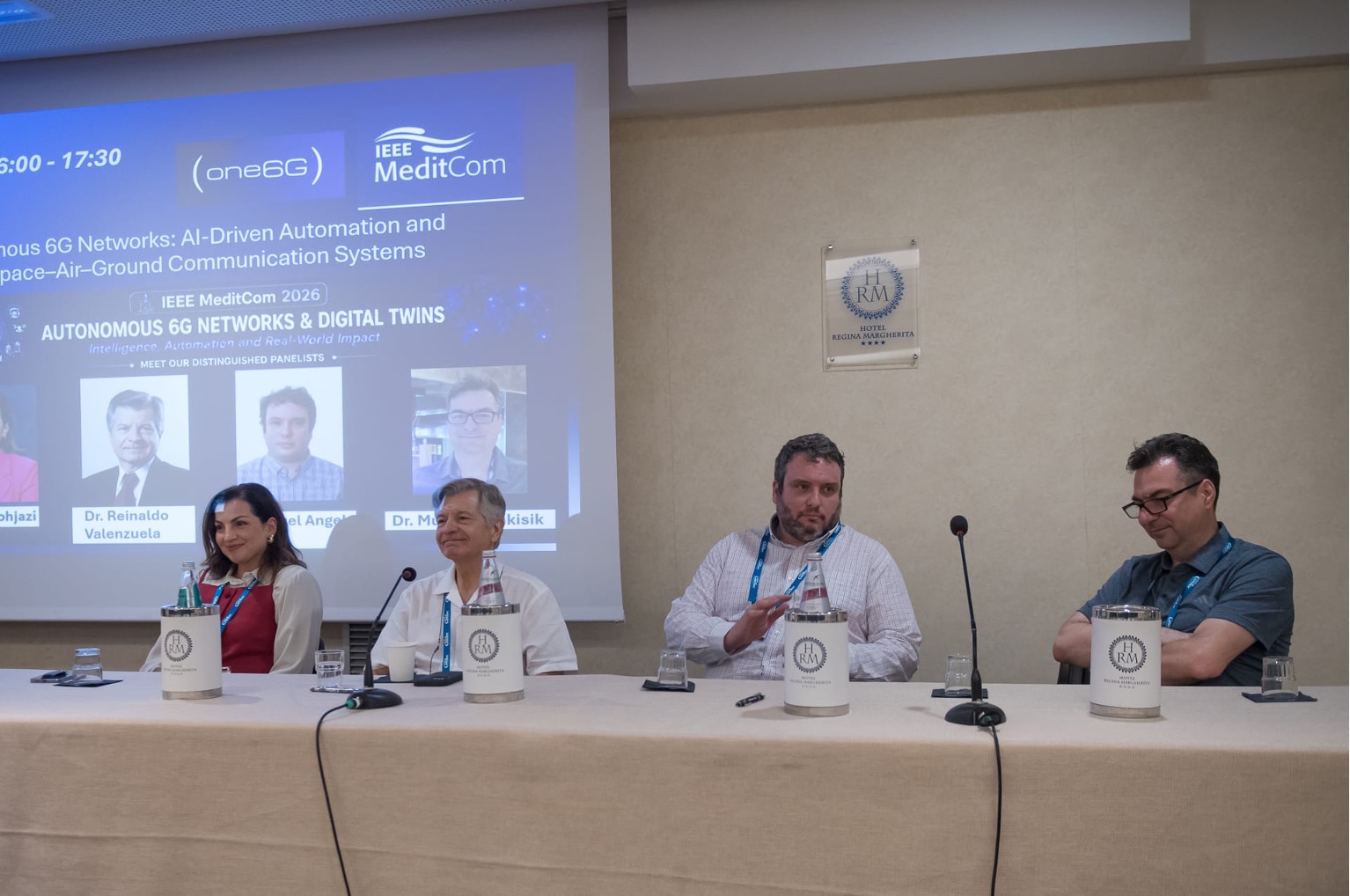
Panel Discussion
Technical Insights Emerging from the Discussion
While the five discussion themes provided the structured framework for the session, the live discussion developed beyond the prepared questions and brought forward several practical and research-oriented issues concerning the implementation of Digital Twins and AI-enabled autonomy in future 6G systems. These observations reflected the complementary expertise of the panellists and the interaction generated through the moderated discussion and audience Q\&A. The discussion particularly highlighted the increasing importance of model fidelity, fresh and reliable data, sensing-enabled network awareness, cross-domain interoperability, distributed intelligence, computation offloading, energy efficiency, openness, and responsible autonomous decision-making. Collectively, these themes suggest that future autonomous 6G systems should be viewed not simply as communication networks enhanced with AI, but as complex cyber–physical ecosystems in which communication, sensing, computation, modelling, and control interact continuously.
- Model Fidelity, Uncertainty, and Autonomous Decision-Making
A particularly important issue emerging from the discussion was the increasing significance of model accuracy and uncertainty as networks move toward greater autonomy. Digital Twins rely on mathematical, data-driven, or hybrid representations of physical communication systems; however, no model can reproduce its physical counterpart perfectly. Modelling errors, incomplete observations, uncertain parameters, changing environmental conditions, and delayed information can all create differences between the physical system and its virtual representation. These differences become particularly important when the Digital Twin is used not only for monitoring or simulation, but also for decision support and closed-loop autonomous control. In a conventional simulation environment, modelling inaccuracies may primarily affect prediction or optimization performance. In an autonomous network, however, an inaccurate or outdated Digital Twin may contribute to decisions that are subsequently applied back to the physical infrastructure. The consequences of model error therefore become more significant as the level of network autonomy increases. The discussion consequently highlighted the need for Digital Twins that are continuously validated, updated, and capable of representing uncertainty. This becomes especially important for time-sensitive applications involving resource allocation, mobility management, network reconfiguration, coordination between autonomous systems, and other functions in which incorrect decisions may directly influence physical operation.
- Fresh Data, Sensing, and Digital Twin Synchronizations
Another recurring theme during the discussion was the importance of fresh, reliable, and context-aware data. The usefulness of a real-time Digital Twin depends fundamentally on how accurately and how recently its virtual representation reflects the state of the corresponding physical system. As network conditions, user behavior, mobility, channel characteristics, and environmental conditions can change rapidly, stale or incomplete data may significantly reduce the reliability of predictions and autonomous decisions. Maintaining an effective Digital Twin therefore requires continuous observation, data collection, synchronization, and model updating. The discussion connected this requirement with emerging sensing capabilities in future communication systems. In particular, Joint Communication and Sensing (JC\&S/JCAS) and novel sensing architectures were identified as potentially important mechanisms for providing continuously updated information about users, objects, network conditions, and the surrounding environment. This suggests that sensing may become more than an additional service in 6G systems. It may form part of the information feedback mechanism required to maintain synchronised Digital Twins and support intelligent network control.
- Heterogeneous Space–Air–Ground Infrastructure
The panel also reinforced the complexity associated with integrating highly heterogeneous communication domains. Future 6G systems may combine terrestrial mobile networks, satellite constellations, aerial platforms, optical infrastructure, edge computing, IoT devices, and cloud-based resources within a common service environment. These domains operate under significantly different physical, computational, and operational constraints. Satellite systems, for example, introduce mobility, propagation delay, orbital dynamics, and resource constraints that differ considerably from those of terrestrial networks. Optical networks provide substantial capacity but are governed by their own physical-layer characteristics, topology constraints, and operational limitations. Edge and IoT infrastructures introduce further challenges related to computational capability, energy availability, data locality, and device heterogeneity. The discussion therefore suggested that a single homogeneous Digital Twin model may not be sufficient for future integrated 6G ecosystems. Instead, domain-aware but interoperable Digital Twins may be required, in which specialized representations of terrestrial, satellite, aerial, optical, edge, and IoT systems can interact within a broader cross-domain framework. Achieving such integration will require common information models, interoperable interfaces, cross-layer coordination, scalable data management, and mechanisms for exchanging information between Digital Twins operating at different network layers and geographical scales.
- Distributed Intelligence, Computation Offloading, and Edge Collaboration
The discussion around computation offloading highlighted that future autonomous 6G intelligence cannot necessarily be concentrated within centralized cloud infrastructure. The network itself will consist of distributed resources including satellites, UAVs, terrestrial base stations, edge nodes, IoT devices, and user equipment, each offering different levels of computational capability, connectivity, latency, and available energy. A key challenge is therefore not only determining what computation should be performed, but also deciding where, when, and using which resources it should be executed. Computation offloading, edge intelligence, and collaborative computing were identified as important mechanisms for distributing intelligence across this heterogeneous infrastructure. Time-critical functions may need to be executed close to the physical system, while computationally intensive optimization or model-training tasks may be better suited to more powerful edge or cloud resources. In highly dynamic environments, these decisions may need to become adaptive. Factors such as communication latency, processing capacity, network congestion, mobility, data availability, and power consumption may all influence the optimal placement of computation. The discussion therefore suggested that the “smartness” of an autonomous 6G network should not simply be measured by the amount of AI deployed. Rather, intelligence should be distributed efficiently and purposefully across the available communication and computing infrastructure.
- Cyber-Physical Automation and Resource Management
An additional insight emerging from the discussion was the increasing interaction between future communication networks and wider cyber-physical automation systems. AI-enabled orchestration can support predictive maintenance, resource management, dynamic network configuration, and resilience. However, in applications such as robotics, autonomous transportation, connected industrial systems, and intelligent infrastructure, network decisions may also influence physical actions. Examples considered during the discussion included resource management, coordination between moving systems, speed matching, and collision avoidance. Such functions illustrate how future communication platforms may become part of larger closed-loop automation architectures involving communication, sensing, computation, control, and physical actuation. This connection introduces additional requirements for reliability, bounded latency, deterministic behavior where necessary, safety, validation of AI-generated decisions, and appropriate interaction between intelligent algorithms and conventional automation or control mechanisms. The discussion therefore highlighted a potentially important research direction at the intersection of 6G communications, Digital Twins, AI, robotics, and industrial automation.
- Energy Efficiency and Sustainable Intelligence
Energy efficiency was also recognized as an important cross-cutting issue. AI-enabled orchestration and Digital Twin technologies may contribute to reducing energy consumption through predictive resource allocation, adaptive infrastructure management, intelligent traffic distribution, and more efficient use of communication resources. At the same time, however, continuous sensing, data exchange, Digital Twin synchronization, AI inference, model training, and distributed computation introduce their own energy requirements. The discussion therefore highlighted an important trade-off: intelligent network management should not improve one component of the system while simply transferring the energy burden elsewhere. Future research should consequently consider the total energy cost across communication, sensing, computation, modelling, and control. This supports a broader concept of \sustainable intelligence, in which the benefit generated by AI is considered alongside the computational and energy resources required to achieve it.
- Openness, O-RAN, Governance, and Human-Centered Autonomy
The final part of the discussion extended beyond technical network performance toward the societal and governance implications of increasingly autonomous infrastructures. Issues including openness, accessibility, fairness, responsible AI, accountability, and governance were raised as important considerations for future system design. The discussion also touched on open network architectures and O-RAN-related concepts, which are relevant to wider questions of interoperability, programmability, innovation, and multi-vendor integration. Greater openness can facilitate innovation and increase flexibility, but it may also introduce additional challenges related to security, verification, accountability, and the governance of increasingly programmable and AI-controlled network functions. The panel therefore reinforced the view that autonomous 6G should be developed as a human-centred and trustworthy technological ecosystem. Performance, latency, capacity, and efficiency alone will not determine successful deployment. Explainability, accountability, fairness, accessibility, privacy, security, sustainability, and appropriate human oversight will also influence whether autonomous communication infrastructures can be responsibly adopted.
Audience Engagement
The panel attracted approximately 25 attendees and developed into a highly interactive and technically engaged session. Rather than remaining limited to the prepared discussion prompts, the conversation expanded organically as participants contributed questions, comments, and practical observations during the Q&A. Audience interest was particularly evident around the real-world implementation of Digital Twins and AI-enabled automation in heterogeneous 6G environments, including the challenges of synchronising virtual and physical systems, managing fresh and reliable data, coordinating intelligence across terrestrial and non-terrestrial domains, and achieving scalable real-time control. The discussion also moved beyond purely technical performance issues to address broader concerns surrounding trust, accountability, explainability, sustainability, security, governance, and the responsible use of AI in increasingly autonomous communication infrastructures. The level of audience participation demonstrated that these topics are not only scientifically timely but also highly relevant to researchers and practitioners considering how 6G concepts can be translated into deployable systems. Overall, the strong interaction added significant value to the panel by creating a genuine exchange between speakers and attendees, allowing multiple perspectives to be explored and reinforcing the importance of multidisciplinary collaboration in shaping future autonomous 6G networks. The Q&A was particularly valuable in moving the discussion from high-level visions of autonomous 6G toward concrete questions of implementation, model validation, scalability, data freshness, distributed computation, uncertainty, and responsible deployment. This interaction strengthened the role of the session as a genuine technical forum rather than a sequence of individual presentations and demonstrated clear interest among participants in translating emerging 6G concepts into practical and deployable systems.
Key Outcomes and Reflections
The discussion resulted in several interconnected observations that extended beyond the original discussion framework.
- Digital Twins can provide a bridge between physical infrastructure and autonomous network intelligence. Their role can extend beyond simulation toward monitoring, prediction, decision support, optimisation, and potentially closed-loop control.
- Model fidelity becomes increasingly critical as autonomy increases. Modelling errors, uncertainty, or stale system representations may influence decisions that are subsequently applied to physical infrastructure. Continuous validation and uncertainty-aware modelling are therefore important requirements.
- Fresh data is fundamental to real-time Digital Twins. Digital Twin effectiveness depends on maintaining synchronizations with the physical system. Emerging sensing capabilities may provide important sources of continuously updated environmental and network information.
- Autonomous 6G requires cross-domain intelligence. Terrestrial, satellite, aerial, optical, edge, and IoT infrastructures operate under different constraints. Future Digital Twins may therefore need to be domain-specific while remaining interoperable.
- The location of intelligence matters. Edge intelligence, collaborative computing, and computation offloading will be important for determining where AI and Digital Twin functions should be performed across cloud, terrestrial, satellite, aerial, edge, and device resources.
- Communication and computation must increasingly be co-designed. Latency, processing capacity, mobility, communication quality, power consumption, and data availability jointly influence where autonomous decisions can practically be made.
- Autonomous communication systems increasingly intersect with cyber–physical automation. Applications involving robotics, autonomous mobility, resource management, and collision avoidance demonstrate the need to consider communication, sensing, computation, and control as interconnected functions.
- Sustainability requires efficient intelligence. AI may reduce network energy consumption, but the computational and energy cost of sensing, Digital Twin synchronisation, model training, and AI inference must also be considered.
- Openness and interoperability remain important. Open architectures and O-RAN-related concepts create opportunities for innovation and multi-vendor integration, while introducing additional questions concerning security, governance, and accountability.
- Trustworthy autonomy must be designed from the beginning. Explainability, accountability, fairness, accessibility, privacy, security, responsible AI, and appropriate human oversight should be considered alongside traditional communication performance indicators.

Panel Q&A Session