
IEEE CSCN 2026 – Event highlights
IEEE CSCN 2026 Connects 6G Research, Standards, and Innovation in London
The IEEE Conference on Standards for Communications and Networking (IEEE CSCN 2026) took place on September 7 to 9, 2026, at King’s College London, bringing together researchers, industry leaders, and standardization experts to discuss the technologies and standards shaping the future of communications.
Held during London 6G Week, alongside the one6G Summit 2026, the conference offered three days of keynote presentations, technical sessions, panel discussions, workshops, and special sessions, creating opportunities to exchange ideas and strengthen international collaboration.
More than 160 attendees from around the world were welcomed to the conference by the General Co-Chairs, Prof. Mohammad Shikh-Bahaei, Dr. Riccardo Trivisonno, and Prof. Periklis Chatzimisios, together with the TPC Co-Chairs, Dr. Aggeliki Sgora and Dr. Alain Mourad.
Keynote Perspectives on the Future of 6G
Four distinguished keynote speakers shared their perspectives on the opportunities and challenges ahead for 6G.
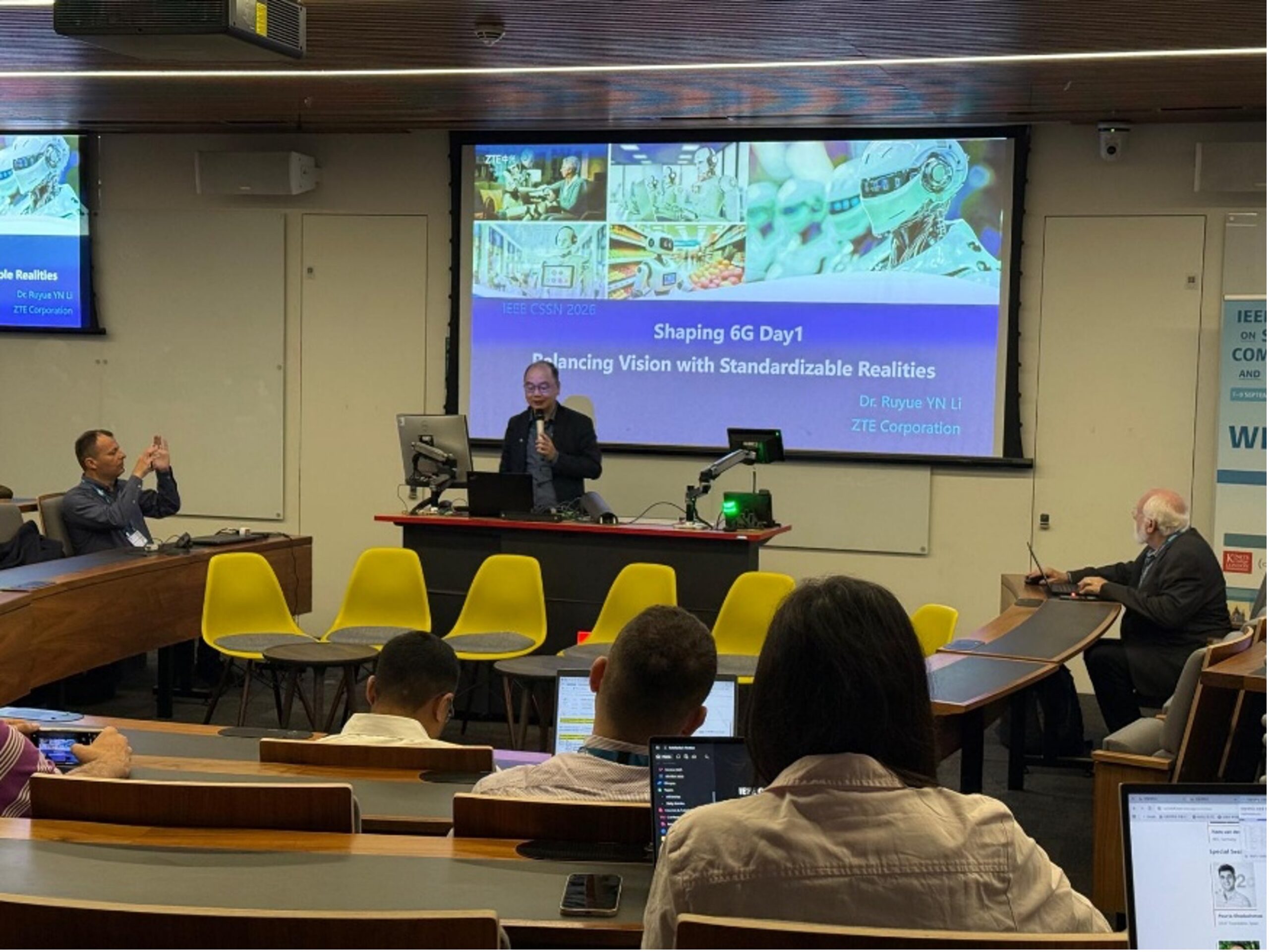
Dr. Ruyue Yu-Ngok Li delivering his keynote on the transition towards 6G
Dr. Ruyue Yu-Ngok Li (ZTE Corporation) discussed the transition from 5G-Advanced to 6G, emphasizing the importance of aligning technological ambitions with commercial needs, energy efficiency, and ongoing 3GPP standardization.
Dr. Xueli An (Huawei Technologies) explored agentic AI-based 6G core networks, where intelligent network agents translate high-level service intents into coordinated actions, enabling more autonomous and adaptive network operations.
Dr. Dorothy Stanley (IEEE Standards Association President) highlighted the ethical challenges and opportunities of artificial intelligence, emphasizing the role of IEEE standards in supporting responsible AI design and deployment.
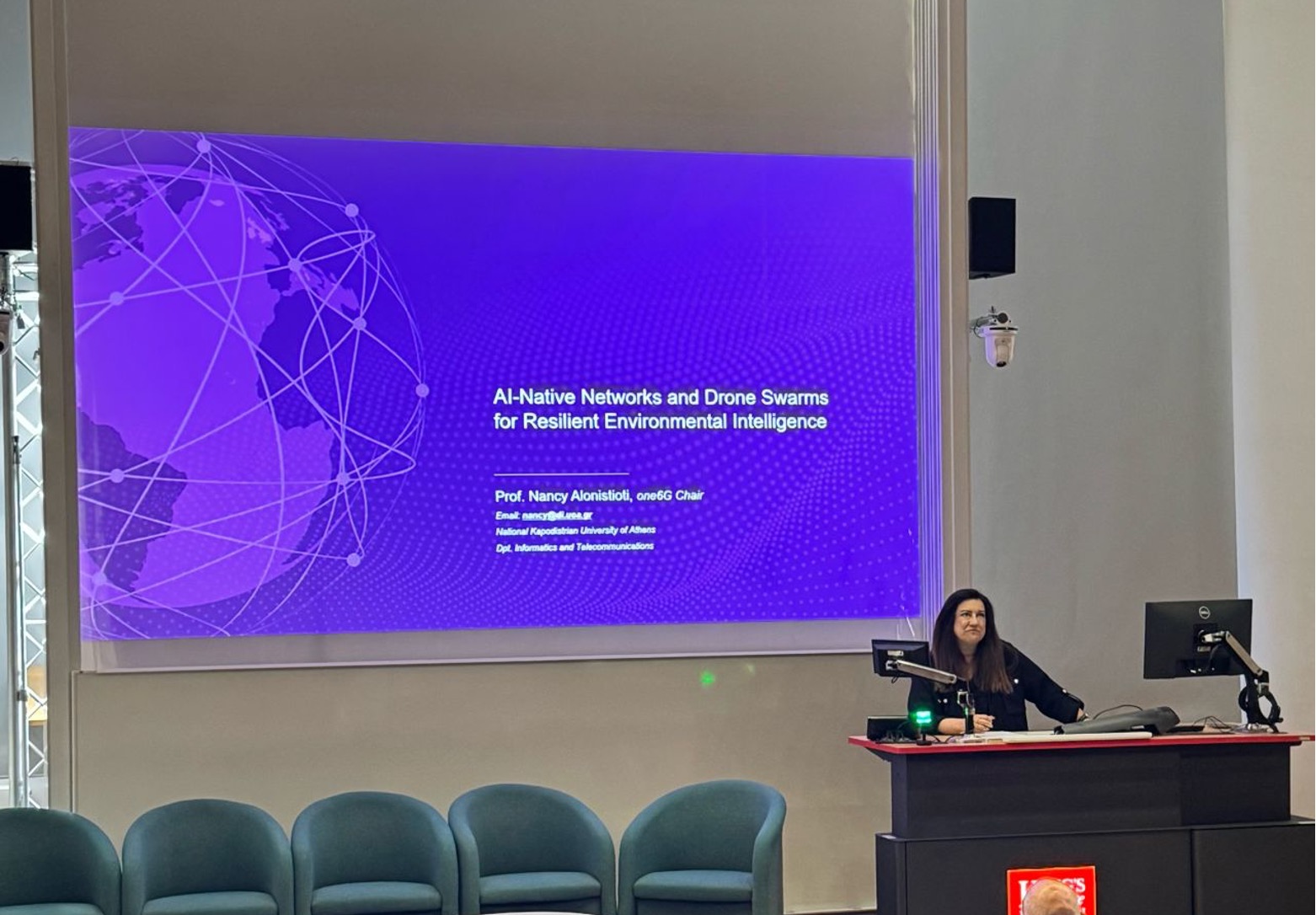
Prof. Nancy Alonistioti presenting her keynote on AI-native networks and drone swarms for resilient environmental intelligence
Prof. Nancy Alonistioti (National and Kapodistrian University of Athens and Chair of the one6G Board) addressed AI-native networks and drone swarms for resilient environmental intelligence, highlighting the potential of intelligent connectivity to support emerging real-world applications.
Bridging Research and Standardization
A central theme of IEEE CSCN 2026 was connecting research advances with practical technologies and future communication standards.
The Executive Forum, “Shaping the 6G Standards Landscape,” brought together experts from industry and standardization organizations to discuss the direction of 6G development. Moderated by Hans van der Veen (NEC Laboratories Europe), the panel featured Prof. Howard Benn, Dr. Aryan Kaushik (one6G WG3 Vice Chair), Sylvia Lu, Dr. Alain Mourad, and Dr. François Ortolan.
The conference also featured two Emerging Communication Standards Update (ECSU) sessions, highlighting recent developments and ongoing standardization activities towards 6G. Presentations addressed AI-native network architectures, integrated sensing and communication (ISAC), non-terrestrial networks, Ambient IoT, and emerging developments within 3GPP and ETSI. These sessions provided an opportunity to connect current research with the evolving 6G standards landscape.
The technical programme was further enriched by special sessions exploring AI-native and intent-driven networking, trustworthy AI, network automation, and the transition from research and software innovation to standards. Nine technical sessions, alongside poster and demonstration sessions, provided opportunities for researchers to present their latest findings and exchange ideas.
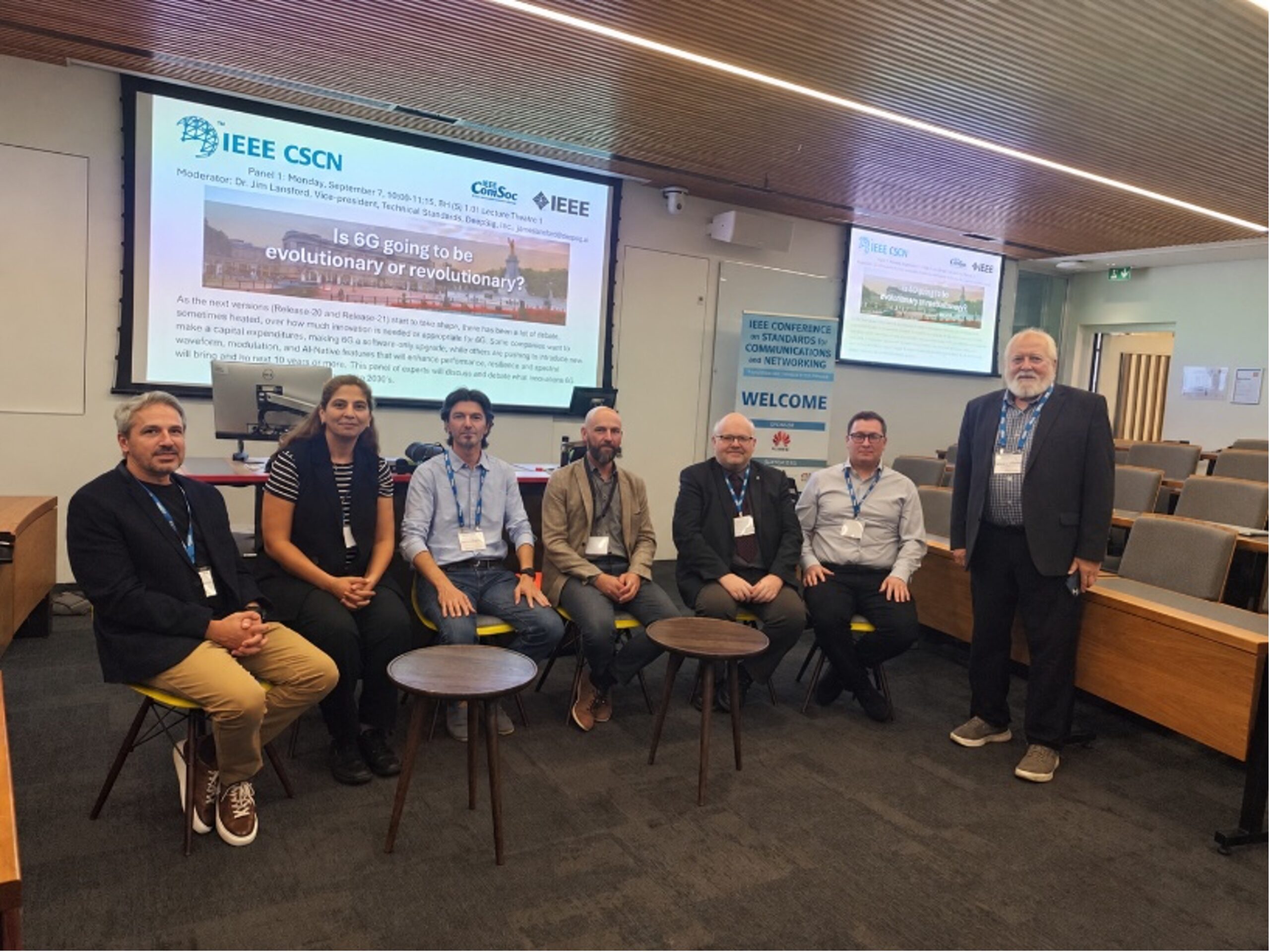
Panel discussion: Is 6G going to be evolutionary or revolutionary?
Connecting 6G with Real-World Applications
IEEE CSCN 2026 also hosted the workshop “6G Empowering Polyfunctional Robotics,” endorsed by one6G and euRobotics. The workshop explored how future wireless networks can support intelligent, connected, and autonomous robotic systems.
Learn more about the Workshop here.
Recognizing Research Excellence
IEEE CSCN 2026 also recognized outstanding research contributions through its Best Paper Awards.
The Best Paper Award was presented to Ali Fuat Sahin, Sefa Kayraklik, Ali Gorcin, Ibrahim Hokelek, Ertugrul Basar, and Halim Yanikomeroglu for their paper “CII: Novel CSI-RS Metric for Joint Precoder and RIS Reporting in Multi-User NextG Networks.”
The Best Student Paper Award went to Rishiraj Sengupta, Sotiris Chatzimiltis, Mohammad Shojafar, and Xiatian Zhu for “Free-Text Evaluation of LLMs for 5G Domain Knowledge and Fault Analysis using LLM-as-Judge.”
The Best Demo/Poster Award recognized Javad Zolfaghari-Bengar, Rakibul Rony, Elisa Gomez de Lope, Alejandro Villena-Rodriguez, Abhinav Mahadevan, and Nicolas Kourtellis for “Hardware-in-the-Loop Phase-Aware CNN for Real-Time 5G Channel Estimation.”
Organization, Patrons, and Supporters
IEEE CSCN 2026 benefited from the efforts of its organizing and technical program committees, speakers, reviewers, authors, and participants.
The conference was supported by Huawei as Diamond Patron and the IEEE Standards Association (IEEE SA) as Gold Patron, with additional support from King’s College London, one6G, Z-RED, and Technology for Society.
Beyond the technical presentations, IEEE CSCN 2026 provided opportunities to reconnect with colleagues, exchange ideas, and explore new research partnerships.
As the journey toward 6G continues, the conference highlighted the importance of bringing together research, industry, and standardization communities to turn technological innovation into practical, interoperable communication systems.